


Federal Research Minister Honors Leibniz-IPHT for Sepsis Research
14. Mai 2019
For developing a light-based rapid procedure to help patients with life-threatening infections receive the right treatment, a research team from the Leibniz-IPHT, together with its European partners, was awarded the Ralf Dahrendorf Prize for the European Research Area by Federal Minister of Education and Research Anja Karliczek in Berlin on May 14, 2019. Professor Jürgen Popp, Scientific Director of the Leibniz-IPHT, expressed his great pleasure at the recognition of the European research project HemoSpec. However, he pointed out that the team now faced a major hurdle: bringing the technological solution to patients. In Germany as well as in Europe, suitable structures for this are lacking, Popp noted. “We need to optimize funding instruments so that researchers can bring their results to market more quickly in collaboration with industry,” Popp urged. He said he was confident that he could start a fruitful dialogue on this topic with the minister: “We must do more to ensure that research reaches patients faster.”
“In intensive care, three things matter,” emphasizes Jena-based intensive care physician Professor Michael Bauer: “Time, time, and time.” With the optical method for rapid diagnosis of life-threatening infections developed under the leadership of the Leibniz-IPHT, “we are in the midst of a technological revolution,” says the head of the Department of Anesthesiology and Intensive Care Medicine at Jena University Hospital. “It allows physicians to treat in a targeted manner, prevent the unnecessary use of antibiotics, and avoid resistance.”
Together with partners from Greece, Italy, Portugal, France, and Denmark, Michael Bauer is part of the research team for the HemoSpec project, which Anja Karliczek honored with the Ralf Dahrendorf Prize for the European Research Area. The Federal Minister of Education and Research uses the award to recognize outstanding projects funded under the EU Framework Programme for Research and Innovation in Germany that present their results to the public in original formats. The award includes prize money of up to €50,000.
“We are very pleased that policymakers not only acknowledge our research but also encourage and support us in bringing our results closer to citizens,” says Jürgen Popp. To this end, the Leibniz-IPHT will, among other activities, open a “science shop” in downtown Jena, where visitors can experience science interactively. “We want to raise awareness of how research translates into applications for patients,” Popp explains.
The Jena team already has concepts for speeding up this process
For a successfully completed project also marks the start of the next major challenge. “We have shown that it is possible to diagnose an infection quickly using our spectroscopy,” says Popp. “Now we want to turn the laboratory prototype into a product.” But in order to bring diagnostic methods to market more quickly, structures in Germany and across Europe need to be improved. From a scientific idea to a finished medical product — the translation from theory into practice — takes an average of 14 years in Germany. Structural hurdles mean that many good ideas and solutions are lost along the way.
To ensure research results reach patients’ bedsides more quickly, new translational infrastructures are needed: “These must enable the structured, modular transfer of a proof of concept into a new, certified, validated, approved, and extensively tested medical product,” says Popp. The best way to achieve this, he argues, is through public–private partnerships.
To accelerate the transfer into medical application, the Jena researchers have already developed concrete concepts for such a translational infrastructure. “We have many ideas on how technologists, basic researchers, and clinical researchers can team up with companies to quickly turn academic solutions into diagnostic devices and therapeutic approaches,” says Popp. “We would be very happy to act as a point of contact for the minister and would welcome the opportunity to discuss our vision with her.”
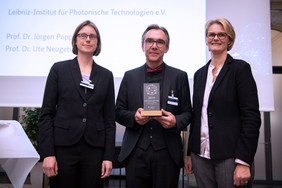
Federal Minister of Education Anja Karliczek presented Ute Neugebauer and Jürgen Popp with the Dahrendorf Prize for the European sepsis research project HemoSpec. Photo: Hans-Peter Rickel
Contact

Related News
Third party cookies & scripts
This site uses cookies. For optimal performance, smooth social media and promotional use, it is recommended that you agree to third party cookies and scripts. This may involve sharing information about your use of the third-party social media, advertising and analytics website.
For more information, see privacy policy and imprint.
Which cookies & scripts and the associated processing of your personal data do you agree with?
You can change your preferences anytime by visiting privacy policy.