


Connecting Knowledge And Fostering Talent

13. Oktober 2024
Leibniz IPHT Organizes International Conferences as Platforms for Collaboration and Careers
Whether new diagnostic methods, innovative laser technologies, or career paths for researchers – scientific progress emerges through exchange. With ICOB, ESULaB, and “Women in Photonics,” Leibniz IPHT organizes conferences that bundle knowledge, build connections, and promote talent.
For Leibniz IPHT, international conferences are more than just forums for expert talks – they bring people together. They enable researchers to discuss current developments, initiate collaborations, and integrate talent early into the international research community. Two regular formats are central to this: the European Symposium on Ultrafast Laser-driven Biophotonics (ESULaB) and the career workshop “Women in Photonics,” which has specifically supported young female scientists since 2018.
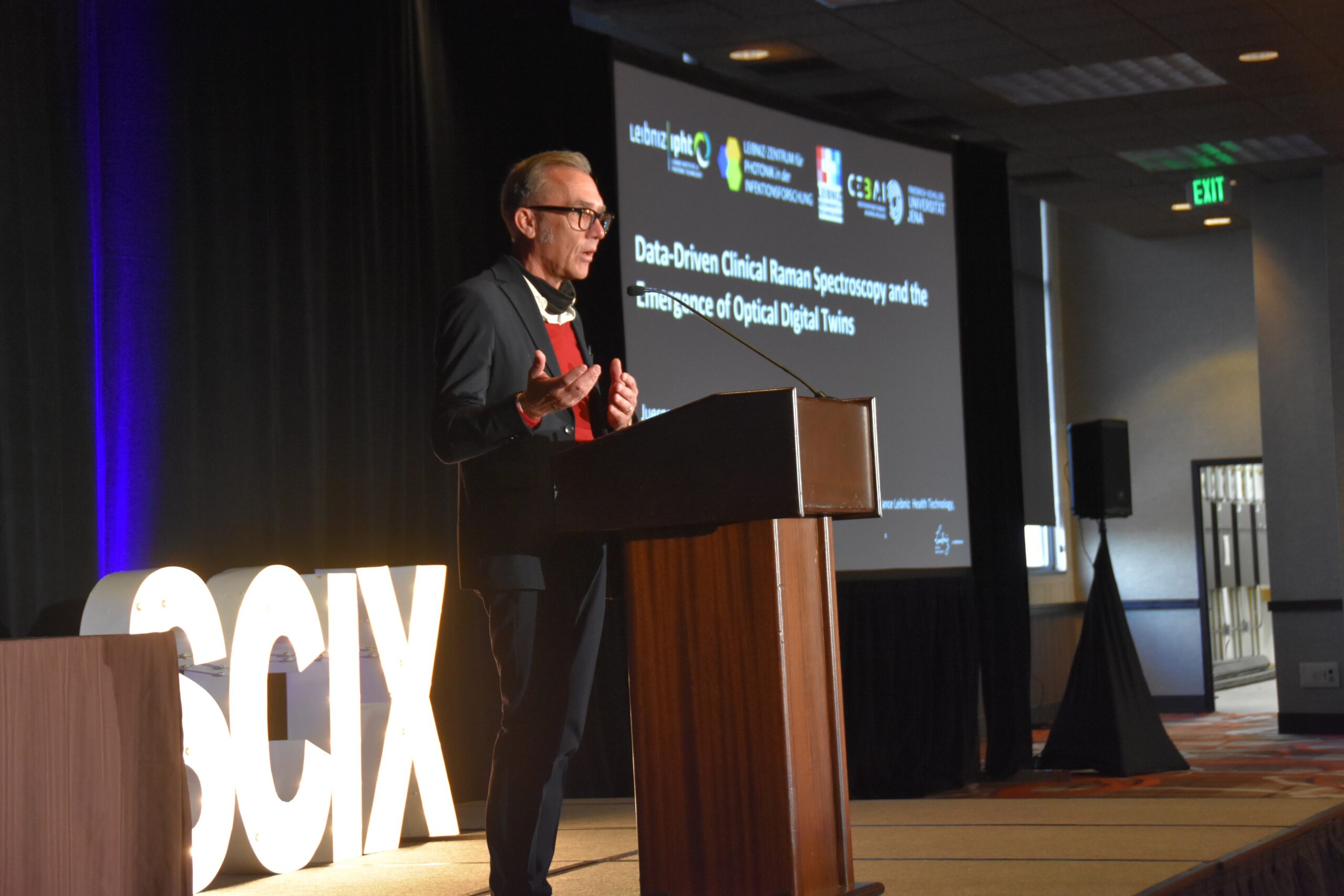
“Our conferences lay the foundation for long-term collaborations and innovative research,” explains Prof. Dr. Jürgen Popp, scientific director of Leibniz IPHT. “They bring together science, industry, and emerging talent and actively promote knowledge transfer into practice.”
DNA Nanotechnology: Precision at the Nanoscale
DNA Nanotechnology 2024 at Leibniz IPHT builds on a long tradition: since 1999, the team led by apl. Prof. Dr. Wolfgang Fritzsche and Dr. Andrea Csáki from the Nanobiophotonics research department has organized the international conference on molecular nanotechnology. Since 2005, a workshop on molecular plasmonics has been held in alternating years.
In 2024, the focus was on DNA superstructures – tiny, self-organizing building blocks that offer new possibilities for sensors and targeted drug delivery.
ICOB 2024: Future Questions in Biophotonics
A highlight was the VII International Congress on Biophotonics (ICOB) in March 2024. More than 350 experts in the field of biophotonics gathered in Jena. The opening keynote was delivered by Nobel Laureate Prof. Dr. Stefan Hell, whose work in super-resolution microscopy has created new opportunities for biomedical research.
Topics ranged from AI-assisted medical imaging and light-based diagnostics for infectious diseases to optical sensors for environmental analysis. A central outcome of the congress was the ICOB white paper, which summarizes current developments and outlines a roadmap for the next ten years. “Biophotonics will play a key role in improving diagnostic and therapeutic procedures in medicine,” emphasizes Popp. “With the white paper, we’re creating a common foundation to strategically develop research, technology transfer, and training on an international level.”
ESULaB 2024: New Applications of Ultrashort Laser Pulses
While ICOB offered an overview of the key topics in biophotonics, the third edition of the European Symposium on Ultrafast Laser-driven Biophotonics (ESULaB) in September 2024 focused on ultrashort laser pulses. Researchers from 20 countries discussed, among other topics, laser-based material analysis for biomedical applications, new methods for real-time analysis of cellular processes, and the use of ultrashort light pulses to study molecular interactions.
“Women in Photonics”: A Springboard for Female Scientists
With the international career workshop “Women in Photonics,” Leibniz IPHT has been supporting early-career female scientists since 2018. The concept is proving successful: Dr. Maria Chernysheva and Dr. Corinna Kufner are two outstanding researchers who were recruited as junior research group leaders.
Chernysheva is developing ultrashort-pulsed fiber lasers for biophotonic applications, while Kufner – who came to Jena from Harvard in 2024 – is investigating the influence of light on chemical processes in abiogenesis, a key to understanding the origin of biological molecules.
Dr. Aleksandra Borek-Dorosz also found her way to Leibniz IPHT through “Women in Photonics” and ICOB. Today, she works as a postdoc in the ERC project LIVE, researching light-based methods to analyze biochemical processes in inflammatory responses and developing new approaches to infrared spectroscopy for medical diagnostics.
“Since my PhD, I’ve been following the research at Leibniz IPHT because I consider it one of the leading centers for clinically oriented photonics in Europe,” she says. “At ICOB, I was able to make valuable contacts – including with Prof. Dr. Ioachim Pupeza and his team. Our exchange led to my current postdoc position at Leibniz IPHT. I was particularly impressed by how open and supportive the community is – it made starting here so much easier.”
Contact

Related News
Third party cookies & scripts
This site uses cookies. For optimal performance, smooth social media and promotional use, it is recommended that you agree to third party cookies and scripts. This may involve sharing information about your use of the third-party social media, advertising and analytics website.
For more information, see privacy policy and imprint.
Which cookies & scripts and the associated processing of your personal data do you agree with?
You can change your preferences anytime by visiting privacy policy.