

From Congress to Roadmap

17. Mai 2025
An International White Paper Outlines the Conditions Required to Accelerate the Translation of Biophotonics Into Clinical, Diagnostic, and Environmental Applications
Light can make diseases visible at earlier stages, guide therapies more precisely, and detect environmental pollution. Many biophotonic methods have already been demonstrated in laboratories and clinical settings—but their path into widespread use is often slow. In a white paper coordinated by Leibniz IPHT, leading international researchers in biophotonics identify key levers to accelerate this translation.
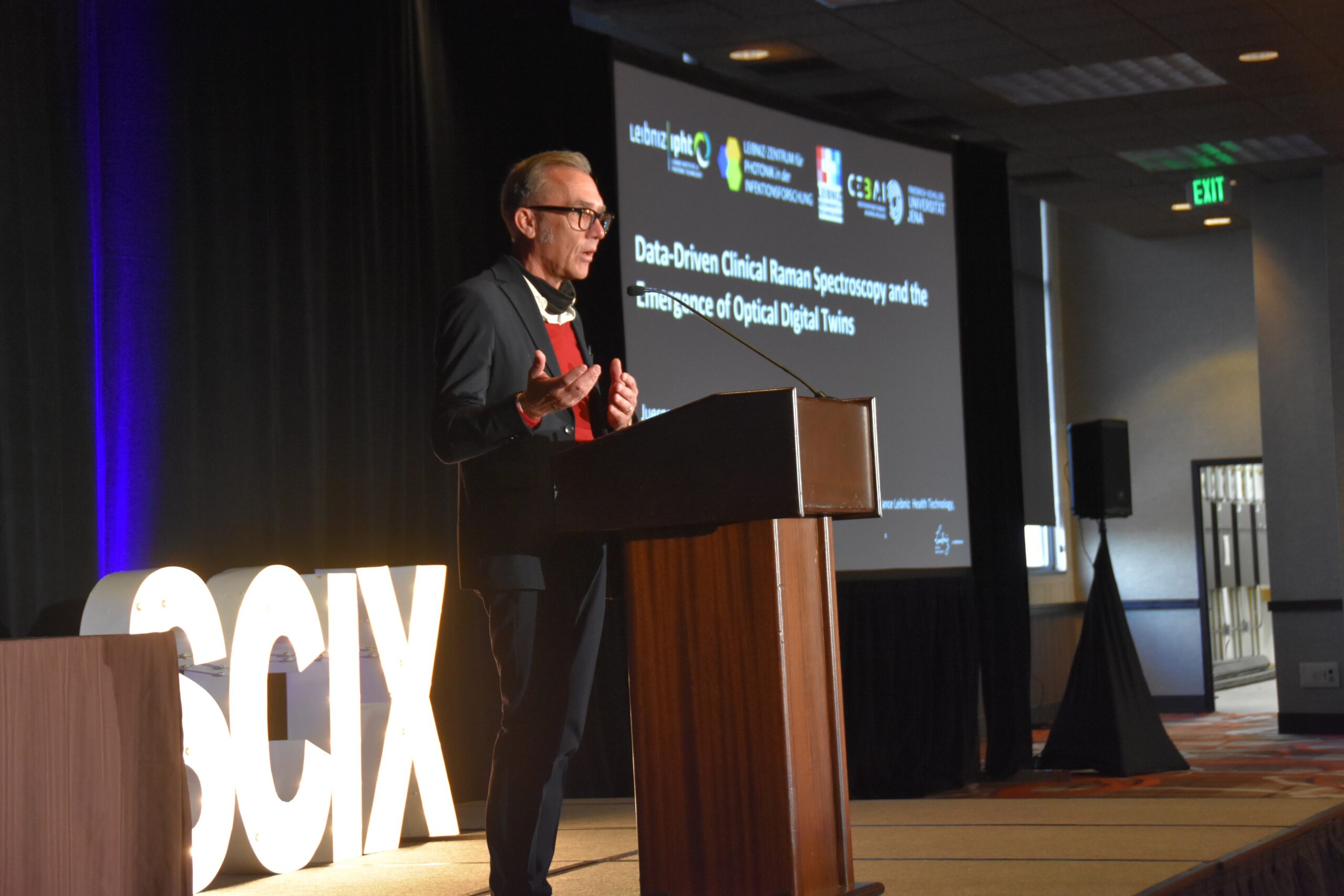
More than 350 experts in light-based technologies gathered in Jena in March 2024 for the 7th International Congress on Biophotonics (ICOB 2024). Topics included AI-assisted medical imaging, optical diagnostics for infectious diseases, and optical sensors for environmental analysis. A central outcome of the congress is the ICOB white paper, which brings together current developments and outlines a roadmap for the next decade.
The initiative was led by the Leibniz-IPHT, which coordinated an international collaboration of ten biophotonics experts from seven countries. The roadmap has been published in the Journal of Biophotonics and is aimed at policymakers in Germany, Europe, and beyond.
“Biophotonics provides powerful technologies. For these to realize their full potential in healthcare and environmental monitoring, appropriate policy frameworks and innovation-friendly regulations are essential,” says Prof. Jürgen Popp, Scientific Director of the Leibniz-IPHT.
Levers for Accelerating Translation
The white paper calls for targeted political and structural measures to accelerate the transfer of light-based technologies—biophotonic methods—into medical, diagnostic, and environmental applications.
The authors identify four central levers:
- Promote translation in a targeted way—through investments in open technology platforms, demonstrators, and clinical studies
- Accelerate regulatory pathways—through standardized evaluation protocols and regulatory innovation spaces
- Strengthen interdisciplinary training—at the interface of physics, biology, medicine, and artificial intelligence
- Increase visibility—through strategic integration into funding programs and health policy agendas
At the core is the concept of translation: the structured transfer of research into real-world application. Only when all steps—from initial idea to prototype and regulatory approval—are coordinated can new technologies reach clinics, laboratories, and environmental monitoring.
Why Biophotonics Matters to Society
Biophotonics uses light to make biological processes visible and measurable—often quickly, precisely, and without physical contact or invasive procedures. Applications range from early detection of cancer and infections to real-time therapy monitoring and the analysis of environmental and food samples.
In this way, biophotonics can help make healthcare systems more resilient, enable faster responses to crises and disease outbreaks, and support continuous monitoring of environmental risks—aligned with a One Health approach that considers human, animal, and environmental health together.
A Model for Successful Translation: The LPI
The white paper’s recommendations are reflected in practice by the Leibniz Center for Photonics in Infection Research (LPI), currently under development in Jena. Funded by the German Federal Ministry of Research, Technology and Space (BMFTR), this open-access platform brings together research, clinical application, and industry in one place—as a “one-stop agency” that supports the innovation process from technology development to regulatory approval.
In addition to the Leibniz-IPHT—contributing its expertise in optical health technologies in close collaboration with clinical and industrial partners—the initiative involves the Leibniz-HKI, Friedrich Schiller University Jena, and Jena University Hospital.
White paper:
Baldini, F., Dholakia, K., French, P., Guntinas-Lichius, O., Kohler, A., Mäntele, W., Marcu, L., Sroka, R., Umapathy, S., & Popp, J. (2025). Shining a Light on the Future of Biophotonics. Journal of Biophotonics, 18(7), e202500148. https://doi.org/10.1002/jbio.202500148
ICOB 2026 in Albany (USA)
The next ICOB 2026 will take place in 2026 at the University at Albany. Together with the Leibniz-IPHT, it operates CeBAI—the Center for Biophotonic Technology and Artificial Intelligence, a transatlantic research center combining light-based technologies with AI for applications in medicine, forensics, and environmental science.
Contact

Scientific Contact