


- Home
- Research
- Optical Molecular Diagnostics and System Technology
- Research results
- Small Dots with Great Potential: How Microarrays from Thuringia Improve the Diagnosis of Infectious Diseases
Small Dots with Great Potential: How Microarrays from Thuringia Improve the Diagnosis of Infectious Diseases
01.09.2023
Detecting infectious agents, recognizing resistance and virulence factors, or determining vaccination status – microarrays are the multifunctional talents of molecular diagnostics and can be flexibly adapted for many diagnostic applications. Experts for this technology at Leibniz IPHT are the scientists of the Research Department Optical Molecular Diagnostics and System Technology. In 2022, the team led by department head, Prof. Dr. Ralf Ehricht, has developed several new tests based on microarray technology together with the developers of INTER-ARRAY by fzmb GmbH from Bad Langensalza, Germany.
In the RESISTOVAC project of the InfectoGnostics Research Campus in Jena, a new test platform was developed with the support of the German Federal Ministry of Education and Research (Bundesministerium für Bildung und Forschung, BMBF), which can be used to determine the vaccination status against a wide range of infectious pathogens. A single drop of blood from patients can be used to test whether the immune system has responded to a vaccination and antibodies against the infectious agent are still present.
The focus was particularly put on the immune response to diseases against which vaccinations are recommended: mumps, measles, tetanus, or diphtheria, but also simultaneous testing for possible corona antibodies due to vaccination or natural infection.
Microarray for all STIKO vaccinations could unveil individual vaccination gaps
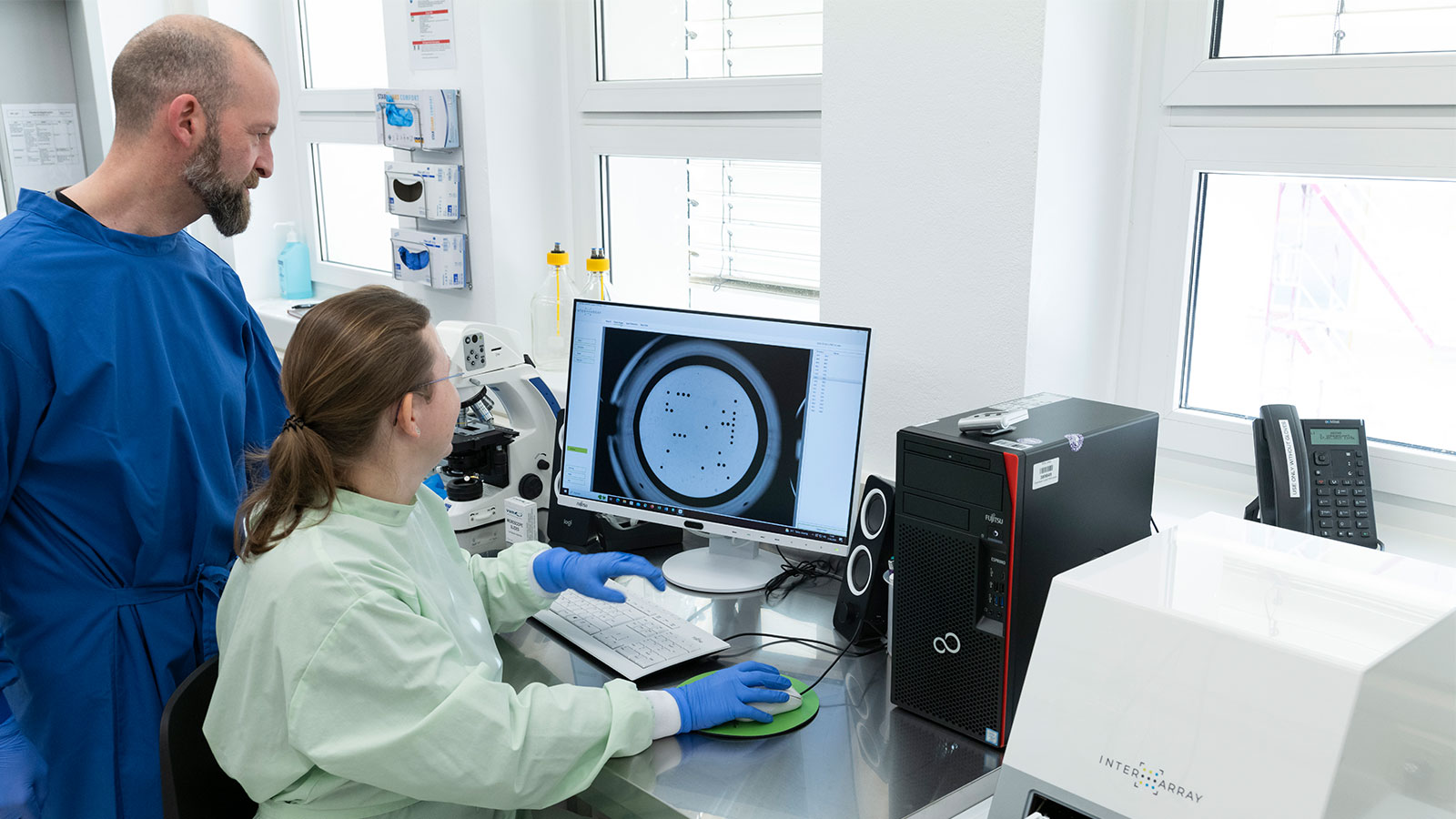
For this purpose, Leibniz IPHT scientists are developing a special protein microarray together with fzmb researchers: On this chip, which is only a few millimeters in size, various capture molecules are applied and bound in small dots. If antibodies from the patient’s blood are brought together with the matching antigens on the chip, corresponding test fields on the microarray change color – hence, a sought-after antibody must have been present in the blood. The resulting tiny pattern on the microarrays can be optically analyzed within a few minutes using special evaluation equipment.
In addition to various surface structures of the corona virus, antigens from the pathogens for diphtheria, measles, and tetanus, to which vaccinated persons typically react, were also brought onto the test. Again, a corresponding antibody response was successfully detected in vaccinated individuals. “We were thus able to show that we can flexibly extend the test, and detect different antibodies in the patient’s blood in the course of a single test. In the future, a microarray could be designed for all vaccinations recommended by the Standing Committee on Vaccination (Ständige Impfkommission, STIKO), which could be used to screen for possible vaccination gaps quickly and inexpensively,” explains Sindy Burgold-Voigt, doctoral student in the Optical Molecular Diagnostics and Systems Technology Research Department at Leibniz IPHT.
Versatile microarray principle can also be transferred to strip test formats
However, the underlying microarray system can also be flexibly adapted to other tests: If, for example, resistance factors are to be detected, or subgroups of a bacterial species are to be determined, researchers can define suitable capture molecules that are applied to the microarray as a dot matrix, and enable parallel measurement of several parameters.
In this way, fzmb GmbH has already been able to develop a market-ready test together with Leibniz IPHT researchers that can be used to investigate genetic properties of the bacterium Staphylococcus aureus and distinguish between more than 700 strains of this pathogen. Virulence factors and resistance genes, including those of the “multidrug-resistant” variants (MRSA), can be rapidly identified with this so-called “INTER-ARRAY Genotyping Kit S. aureus” test kit. The company cooperated with the Leibniz IPHT scientists Prof. Ralf Ehricht and Dr. Stefan Monecke to select the target genes and sequences, and to build the database of strains.
Microarray systems also offer the great advantage that they can be implemented in various diagnostic test formats. Thus, the principle can also be transferred in a simplified form to a low-cost strip test format, as is known from corona rapid tests. In the RESISTOVAC project, this further development is being undertaken by Senova GmbH in Weimar, Germany, which specializes in such lateral flow test methods.
InfectoGnostics Research Campus Jena
Leibniz IPHT is a founding member of the InfectoGnostics Research Campus, which is a Thuringian innovation cluster for diagnostics and biotechnology that initiates joint translational projects in public-private partnership, and accompanies them until application. More than 30 partners from industry, research and clinical practice develop and combine photonic and molecular biological methods in the research campus in order to reliably detect infectious agents and antibiotic resistance, and to better understand the host response (for example in sepsis). In the triad consisting of technology, application and production, laboratory and rapid tests are created for use in human and veterinary medicine as well as for food safety.
Further information on InfectoGnostics Research Campus Jena: www.infectognostics.de
In the picture:
Employees of the Optical Molecular Diagnostics and Systems Technology Research Department performing mircroarray diagnostics.
©Sven Döring